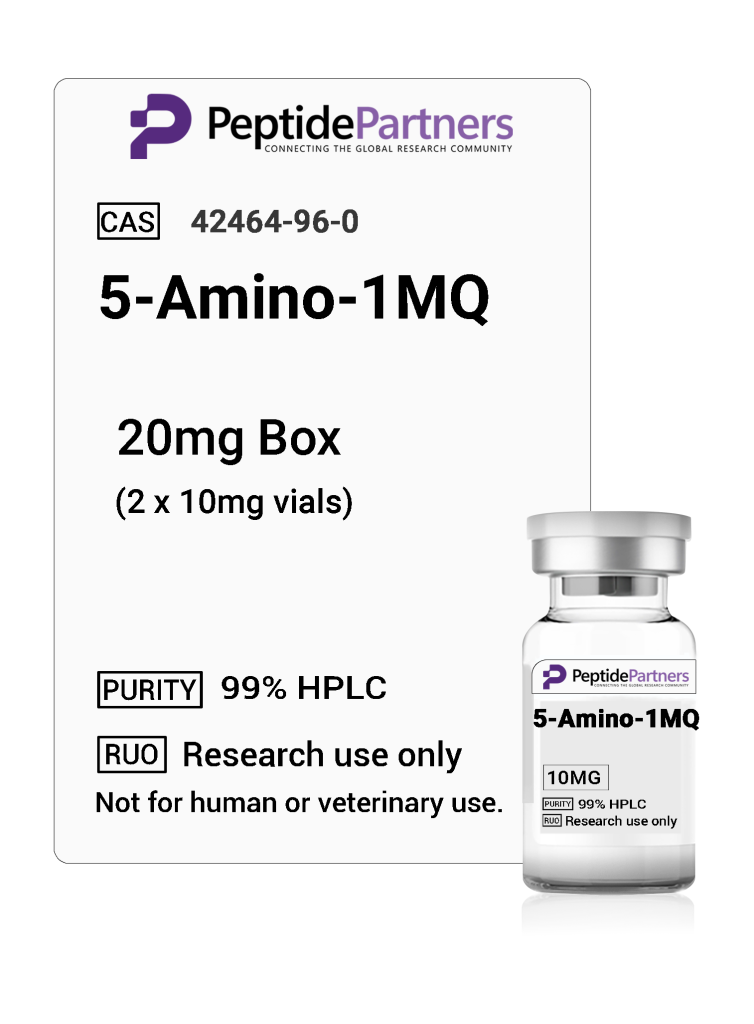

5-Amino-1MQ (10mg vials)
Price range: $56.00 through $195.00
-
Research compound: 5-Amino-1MQ, also known as 5-amino-1-methylquinolinium.
-
Primary molecular target: Nicotinamide N-methyltransferase (NNMT).
-
Format: 10 mg vials with 3 mL vial capacity.
-
Available box combinations: 20 mg, 50 mg, and 100 mg.
-
Purity: 99.66% multi-vial purity.
-
Testing status: Doubly validated, independently tested, and passed purity, endotoxin, and heavy-metals screening.
-
Batch details: Manufacturer ID WF03; batch AM202604.
-
Chemical identifiers: CAS 42464-96-0; molecular formula C₁₀H₁₁IN₂.
-
Research role: Studied in cellular and preclinical models investigating NNMT inhibition, NAD⁺ and SAM metabolism, lipogenesis, adipose-tissue biology, and metabolic pathways.
- Independent certificate details, manufacturer IDs, and batch IDs should be reviewed before purchase when available.
- Order cancellations for full refunds are available before shipment; shipped orders cannot be cancelled or refunded.
- For damaged or incorrect goods, photograph the outer packaging, inner packaging, and product labels, then email support within 48 hours of carrier delivery.
Buy 5-Amino-1MQ – Peptide Partners
Product Overview & Specifications
5-Amino-1MQ, also known as 5-amino-1-methylquinolinium, is a small-molecule nicotinamide N-methyltransferase (NNMT) inhibitor supplied by Peptide Partners for in-vitro testing, laboratory experimentation, and metabolic or preclinical research.
NNMT is an enzyme involved in nicotinamide metabolism and methyl-donor balance. Research involving 5-Amino-1MQ has focused on how selective NNMT inhibition may influence intracellular 1-methylnicotinamide, NAD+, S-adenosylmethionine (SAM), lipogenesis, adipose-tissue biology, and related metabolic pathways. These findings are limited to laboratory and animal research and do not establish human safety, efficacy, or clinical outcomes.
Product Specifications
| Specification | Details |
|---|---|
| Product name | 5-Amino-1MQ |
| Alternate name | 5-amino-1-methylquinolinium |
| Research target | Nicotinamide N-methyltransferase (NNMT) |
| CAS number | 42464-96-0 |
| Molecular formula | C10H11IN2 |
| Product format | 10 mg vials |
| Vial capacity | 3 mL |
| Available box combinations | 20 mg, 50 mg, and 100 mg |
| Multi-vial purity | 99.66% |
| Validation | Doubly validated |
| Independent testing | Yes |
| Endotoxin screening | Passed |
| Heavy-metals screening | Passed |
| Purity screening | Passed |
| Manufacturer ID | WF03 |
| Batch ID | AM202604 |
| Cost per milligram | $1.95–$2.80 |
The stated 99.66% purity is based on multi-vial testing. Researchers should review the applicable batch documentation and certificate of analysis before beginning any experiment.
Primary Research Studies & Findings
Selective and Membrane-Permeable Small Molecule Inhibitors of Nicotinamide N-Methyltransferase Reverse High Fat Diet-Induced Obesity in Mice
Authors: Harshini Neelakantan, Virginia Vance, Michael D. Wetzel, Hua-Yu Leo Wang, Stanton F. McHardy, Celeste C. Finnerty, Jonathan D. Hommel, and Stanley J. Watowich
Publication: Biochemical Pharmacology, 2018;147:141–152
Reference: PubMed 29155147
This preclinical study evaluated methylquinolinium-based NNMT inhibitors, including 5-amino-1-methylquinolinium. The researchers reported that the compound demonstrated membrane permeability and selectivity for NNMT in the study systems. They also examined whether NNMT inhibition affected structurally related SAM-dependent methyltransferases or enzymes associated with the NAD+ salvage pathway.
In cultured adipocytes, NNMT inhibition was associated with lower intracellular 1-methylnicotinamide, increased NAD+ and SAM availability, and reduced lipogenesis-related activity. In diet-induced obese mice, systemic administration of an NNMT inhibitor was associated with reductions in body weight, white adipose-tissue mass, adipocyte size, and plasma total cholesterol during the study period.
Plain-English Research Summary
This study examined NNMT inhibition rather than appetite suppression. It explored how altering NNMT-related metabolism affected cultured adipocytes and diet-induced obese mice. The results were preclinical and do not demonstrate human safety, efficacy, or treatment outcomes.
Reduced Calorie Diet Combined With NNMT Inhibition Establishes a Distinct Microbiome in DIO Mice
Authors: Andrea Dimet-Wiley, Qinglong Wu, Jerrin T. Wiley, Aditya Eswar, Harshini Neelakantan, Tor Savidge, and Stanley J. Watowich
Publication: Scientific Reports, 2022;12:358
Reference: PubMed 35013352
This study examined diet-induced obese mice exposed to an NNMT inhibitor identified as 5-amino-1-methylquinolinium while transitioning from a Western or high-fat diet to a low-fat diet. The researchers used 16S rRNA sequencing and adipose-tissue metabolite-correlation analyses to assess treatment-associated microbial and metabolic changes.
The combined diet switch and NNMT-inhibition protocol produced a distinct cecal microbiome profile compared with the diet switch alone. Reported differences included increased Lactobacillus and decreased Erysipelatoclostridium, alongside microbiome patterns correlated with normalization of body-weight and adiposity measurements toward lean-control levels in the experimental model.
Plain-English Research Summary
This mouse study explored whether NNMT inhibition could influence gut-microbiome patterns during diet-associated weight change. It reported a different microbial profile when NNMT inhibition was combined with dietary intervention. The findings remain limited to animal research and should not be interpreted as evidence of a human treatment effect.
Roles of Nicotinamide N-Methyltransferase in Obesity and Type 2 Diabetes
Authors: Jie-Ru Liu, Zhao-Hui Deng, Xiao-Juan Zhu, Yu-Rong Zeng, Xiang-Xiang Guan, and Jiang-Hua Li
Publication: BioMed Research International, 2021
Reference: PMC8337113
This review summarizes the role of NNMT in obesity and type 2 diabetes research. NNMT methylates nicotinamide using S-adenosylmethionine, linking the enzyme to studies of NAD+ salvage chemistry, methyl-donor balance, and energy-metabolism pathways.
The review discusses 5-Amino-1MQ as a membrane-permeable NNMT inhibitor and summarizes preclinical findings involving intracellular 1-methylnicotinamide, NAD+, lipogenesis, energy expenditure, adipose-tissue mass, and insulin-sensitivity markers in cellular and animal models.
Plain-English Research Summary
This review places 5-Amino-1MQ within the wider NNMT research field. It explains why researchers investigate NNMT in relation to nicotinamide metabolism, NAD+ biology, methyl-group handling, lipid metabolism, and glucose-related pathways. The strongest evidence remains cellular and preclinical.
Standard Research Disclaimer
Research Use Only. Not for use in diagnostic tests.
This product is solely intended for research purposes as a chemical compound. It is designated exclusively for in-vitro testing and laboratory experimentation. All information provided about this product is educational and should be evaluated by appropriately qualified research personnel.
By law, bodily introduction of this product into humans or animals is strictly prohibited. This compound must not be used, administered, or represented as a drug, food, dietary supplement, cosmetic, diagnostic material, or medical treatment. It is not intended to diagnose, treat, cure, or prevent any disease. It should be handled only by licensed and qualified professionals in an appropriately equipped laboratory and in accordance with applicable laws, institutional procedures, and relevant safety requirements.
| Choose pack |
2 vials × 10mg (20mg total) ,5 vials × 10mg (50mg total) ,10 vials × 10mg (100mg total) |
|---|
- All of our manufacturing partners produce peptides using the Lyophilization (Freeze Drying) process, ensuring products maintain stability for shipping and storage for 12+ months.
- In lyophilized form, they are shelf-stable for many weeks. However, for long-term storage, it is recommended to store them in the freezer.
- We often hear concerns about the standard "discard after 28 days of first use" disclaimer. Don't worry, this has nothing to do with studies regarding the efficacy of specific peptides. 28 days is the FDA requirement for producers of multi-use vials to prove their bacteriostatic maintains efficacy. This minimum requirement becomes the de facto standard.
- In our experience, if you use proper sterile procedures and refrigerated storage, you can continue sampling from the same reconstituted vial for 3+ months.
Certificate records
No published certificate records are available for this product.
Search Certificate LedgerRelated products
Cagrilintide (10mg vials)
Price range: $335.00 through $1,050.00
GLP-1 Semaglutide (10mg vials)
Price range: $285.00 through $976.00
GLP-2 Tirzepatide (40mg vials)
Price range: $260.00 through $3,090.00
GLP-3 Retatrutide (24mg vials)
Price range: $230.00 through $1,512.00
Ipamorelin (10mg vials)
Price range: $82.00 through $577.00
Sermorelin (10mg vials)
Price range: $98.00 through $797.00