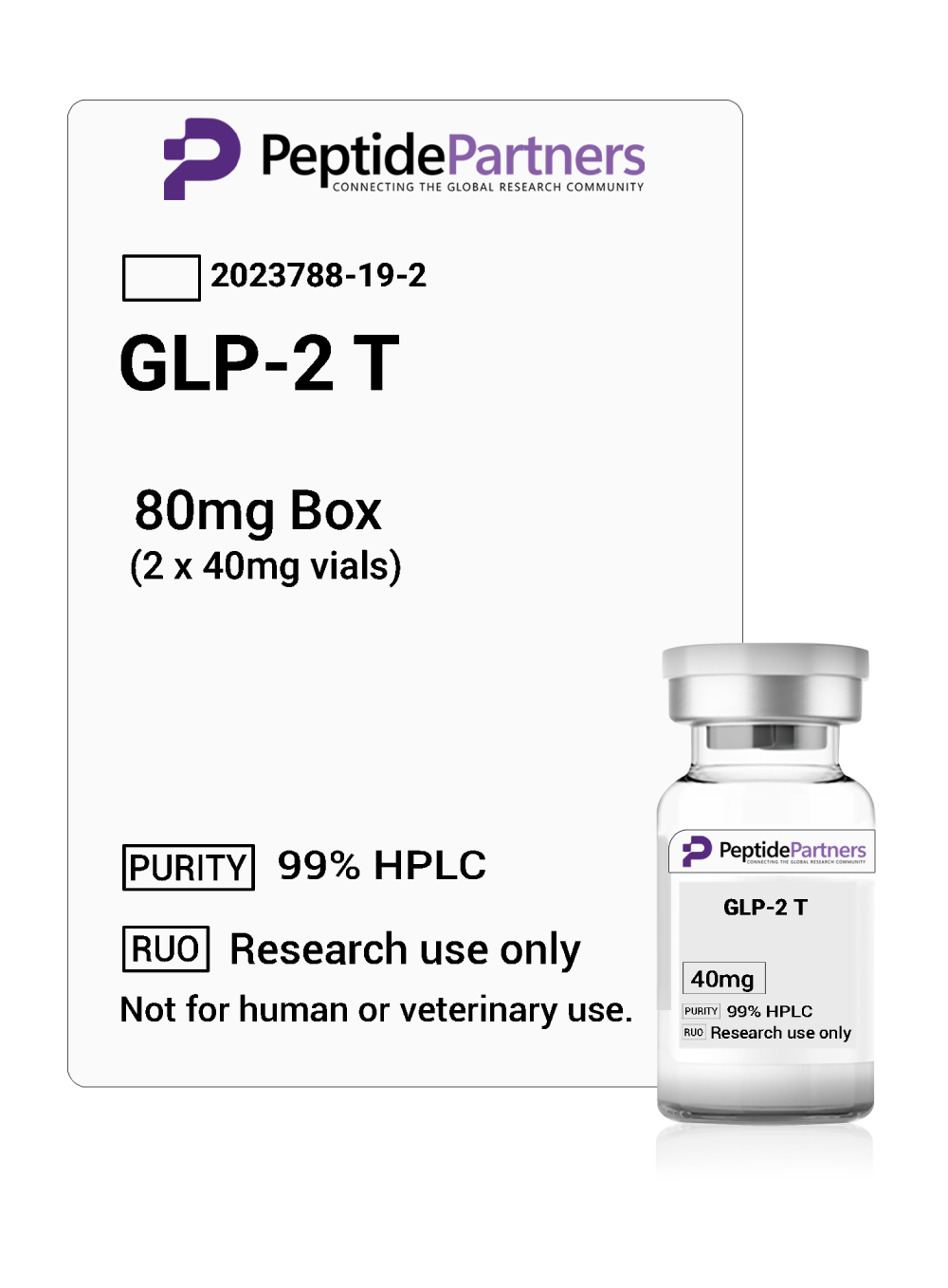


GLP-2 Tirzepatide (40mg vials)
Price range: $260.00 through $3,090.00
-
Research peptide: GLP-2 Tirzepatide, a dual GIP and GLP-1 receptor agonist research compound.
-
Primary molecular targets: Glucose-dependent insulinotropic polypeptide receptor (GIPR) and glucagon-like peptide-1 receptor (GLP-1R).
-
Format: 40 mg vials with 3 mL vial capacity.
-
Available box combinations: 80 mg, 200 mg, 400 mg, 800 mg, and 1,200 mg.
-
Purity: 99.44% multi-vial purity.
-
Testing status: Doubly validated and independently tested; purity, endotoxin, and heavy-metals screenings passed.
-
Batch details: Manufacturer ID WF03; batch TZ202605.
-
Research focus: Dual-receptor pharmacology, biased signaling, adipocyte metabolism, insulin-related cellular pathways, oxidative-stress models, and preclinical research.
- Independent certificate details, manufacturer IDs, and batch IDs should be reviewed before purchase when available.
- Order cancellations for full refunds are available before shipment; shipped orders cannot be cancelled or refunded.
- For damaged or incorrect goods, photograph the outer packaging, inner packaging, and product labels, then email support within 48 hours of carrier delivery.
Buy GLP-2 Tirzepatide – Peptide Partners
Product Overview & Specifications
GLP-2 Tirzepatide is a dual glucose-dependent insulinotropic polypeptide and glucagon-like peptide-1 receptor agonist research compound supplied by Peptide Partners for in-vitro testing, laboratory experimentation, receptor pharmacology, cellular metabolism studies, and preclinical research.
Published studies have examined tirzepatide at GIPR and GLP-1R, including receptor occupancy, cAMP signaling, β-arrestin recruitment, receptor internalization, adipocyte nutrient metabolism, pancreatic-islet signaling, oxidative-stress pathways, and kidney-cell models.
The product name supplied for this listing is “GLP-2 Tirzepatide.” The cited literature generally identifies the research compound as tirzepatide, a dual GIPR/GLP-1R agonist. Researchers should verify the exact identity, sequence, formulation, and batch-specific documentation before beginning any experiment.
Product Specifications
| Specification | Details |
|---|---|
| Product name | GLP-2 Tirzepatide |
| Compound type | Dual GIPR/GLP-1R agonist research compound |
| Primary molecular targets | GIP receptor (GIPR) and GLP-1 receptor (GLP-1R) |
| Primary research areas | Receptor signaling, adipocyte metabolism, pancreatic-islet biology, oxidative-stress research, and preclinical metabolic studies |
| Product format | 40 mg vials |
| Vial size | 40 mg |
| Vial capacity | 3 mL |
| Available box combinations | 80 mg, 200 mg, 400 mg, 800 mg, and 1,200 mg |
| Multi-vial purity | 99.44% |
| Validation | Doubly validated |
| Independent testing | Yes |
| Endotoxin screening | Passed |
| Heavy-metals screening | Passed |
| Purity screening | Passed |
| Manufacturer ID | WF03 |
| Batch ID | TZ202605 |
| Cost per milligram | $2.58–$3.25 |
The stated 99.44% purity is based on multi-vial testing. Researchers should review the batch-specific certificate of analysis before beginning any experiment.
Primary Research Studies & Findings
Tirzepatide Is an Imbalanced and Biased Dual GIP and GLP-1 Receptor Agonist
Authors: Francis S. Willard, Jonathan D. Douros, Aaron D. Showalter, David B. Wainscott, Todd M. Suter, Megan E. Capozzi, Guemalli R. Cardona, Shweta Urva, Paul J. Emmerson, Mette R. Rosenkilde, Jonathan E. Campbell, and Kyle W. Sloop
Publication: JCI Insight, 2020;5(17):e140532
DOI: 10.1172/jci.insight.140532
Reference: View publication
This study characterized tirzepatide activity at human GIPR and GLP-1R using receptor-binding assays, defined-receptor-density cell systems, cAMP assays, GTPγS signaling, β-arrestin-recruitment assays, receptor-internalization experiments, and isolated pancreatic-islet preparations.
The researchers reported that tirzepatide had activity comparable to native GIP at GIPR but lower potency and partial agonist activity at GLP-1R in selected assays. At GLP-1R, tirzepatide favored cAMP signaling relative to β-arrestin recruitment and produced less receptor internalization than native GLP-1. The study also reported full agonism at GIPR and a different receptor-trafficking profile between GIPR and GLP-1R.
These results provide a mechanistic description of receptor signaling in experimental systems. They do not establish that the supplied product produces the same activity profile unless its identity, purity, sequence, and formulation are analytically confirmed.
Plain-English Research Summary
This study examined how tirzepatide interacts with two receptor systems in laboratory assays. The researchers found stronger activity at GIPR and a different signaling pattern at GLP-1R, including greater cAMP preference and less β-arrestin recruitment in the tested models. The results help describe receptor pharmacology but do not establish human treatment effects for this research material.
Tirzepatide Modulates the Regulation of Adipocyte Nutrient Metabolism Through Long-Acting Activation of the GIP Receptor
Authors: Ajit Regmi, Eitaro Aihara, Michael E. Christe, Gabor Varga, Thomas P. Beyer, Xiaoping Ruan, Emily Beebe, Libbey S. O’Farrell, Melissa A. Bellinger, Aaron K. Austin, Yanzhu Lin, Haitao Hu, Debra L. Konkol, Samantha Wojnicki, Adrienne K. Holland, Jessica L. Friedrich, Robert A. Brown, Amanda S. Estelle, Hannah S. Badger, Gabriel S. Gaidosh, and William Roell
Publication: Cell Metabolism, 2024
Reference: View publication
This study examined long-acting GIPR agonism in human adipocyte systems and mouse models. The researchers evaluated insulin signaling, glucose uptake, conversion of glucose to glycerol, lipolysis, circulating triglycerides, and adipose-tissue uptake of lipoprotein-derived fatty acids.
In the tested adipocyte models, GIPR agonism enhanced insulin-associated glucose uptake and glucose-to-glycerol conversion. In the absence of insulin, the agonist conditions were associated with increased lipolysis. In diet-induced obese mice, long-acting GIPR agonism was associated with lower triglyceride levels during an oral lipid challenge and increased uptake of lipoprotein-derived fatty acids into adipose tissue.
The study primarily investigated long-acting GIPR agonism and should not be presented as a direct evaluation of every tirzepatide formulation. The experimental results are model-specific and do not establish human metabolic outcomes.
Plain-English Research Summary
This study examined how long-acting GIP-receptor activation affects fat cells in laboratory and mouse models. The researchers observed different nutrient-handling responses depending on whether insulin was present. These findings help characterize adipocyte signaling but do not demonstrate that the supplied product treats obesity, diabetes, or any related condition.
GLP-1/GIP Dual Agonist Tirzepatide Modulates Diabetic Nephropathy via PI3K/AKT-Mediated Suppression of Oxidative Stress
Authors: Yan Tian, Ruixue Tian, He Juan, Yafan Guo, Pan Yan, Yao Cheng, Rongshan Li, and Baodong Wang
Publication source: Biomedicine & Pharmacotherapy, 2025
Reference: View publication
This study evaluated tirzepatide in diabetic mice and in cultured podocytes exposed to high-glucose conditions. The researchers assessed oxidative-stress markers, the PI3K/AKT pathway, podocyte injury, and kidney-related measurements in the animal model.
The study reported activation of PI3K/AKT signaling and changes in oxidative-stress markers in high-glucose-exposed podocytes. Inhibition of PI3K reduced the observed antioxidative response in the cell model, supporting a role for that pathway in the reported mechanism. The mouse experiments included metabolic and urinary endpoints, but these findings remain limited to the specific animal and cell models used.
Plain-English Research Summary
This study examined tirzepatide in a high-glucose podocyte model and in diabetic mice. The researchers investigated whether PI3K/AKT signaling was associated with changes in oxidative-stress responses and podocyte injury markers. The results are preclinical and do not establish kidney protection or a medical treatment effect in humans.
Standard Research Disclaimer
Research Use Only. Not for use in diagnostic tests.
This product is solely intended for research purposes as a chemical compound. It is designated exclusively for in-vitro testing and laboratory experimentation. All information provided about this product is educational and should be evaluated by appropriately qualified research personnel.
By law, bodily introduction of this product into humans or animals is strictly prohibited. This compound must not be used, administered, or represented as a drug, food, dietary supplement, weight-management product, diagnostic material, or medical treatment. It is not intended to diagnose, treat, cure, or prevent any disease. It should be handled only by licensed and qualified professionals in an appropriately equipped laboratory and in accordance with applicable laws, institutional procedures, and relevant safety requirements.
| Choose pack |
2 vials × 40mg (80mg total) ,5 vials × 40mg (200mg total) ,10 vials × 40mg (400mg total) ,20 vials × 40mg (800mg total) ,30 vials × 40mg (1200mg total) |
|---|
- All of our manufacturing partners produce peptides using the Lyophilization (Freeze Drying) process, ensuring products maintain stability for shipping and storage for 12+ months.
- In lyophilized form, they are shelf-stable for many weeks. However, for long-term storage, it is recommended to store them in the freezer.
- We often hear concerns about the standard "discard after 28 days of first use" disclaimer. Don't worry, this has nothing to do with studies regarding the efficacy of specific peptides. 28 days is the FDA requirement for producers of multi-use vials to prove their bacteriostatic maintains efficacy. This minimum requirement becomes the de facto standard.
- In our experience, if you use proper sterile procedures and refrigerated storage, you can continue sampling from the same reconstituted vial for 3+ months.
Certificate records
No published certificate records are available for this product.
Search Certificate LedgerRelated products

5-Amino-1MQ (10mg vials)
Price range: $56.00 through $195.00
Cagrilintide (10mg vials)
Price range: $335.00 through $1,050.00
GLP-1 Semaglutide (10mg vials)
Price range: $285.00 through $976.00
GLP-3 Retatrutide (24mg vials)
Price range: $230.00 through $1,512.00
Ipamorelin (10mg vials)
Price range: $82.00 through $577.00
Sermorelin (10mg vials)
Price range: $98.00 through $797.00