
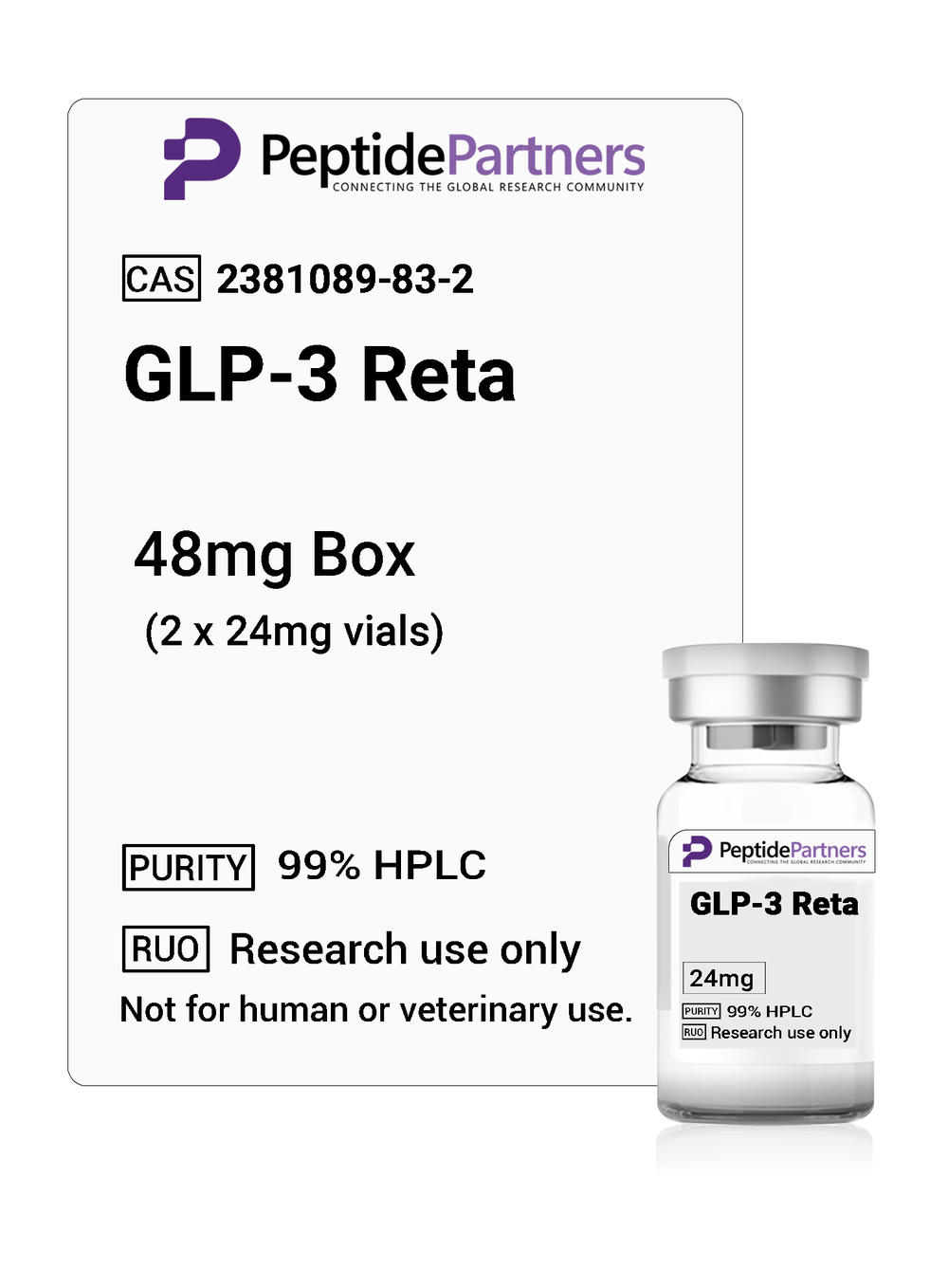

GLP-3 Retatrutide (24mg vials)
Price range: $230.00 through $1,512.00
-
Research peptide: GLP-3 Retatrutide, a triple receptor agonist research compound.
-
Primary molecular targets: GLP-1 receptor (GLP-1R), GIP receptor (GIPR), and glucagon receptor (GCGR).
-
Format: 24 mg vials with 3 mL vial capacity.
-
Available box combinations: 48 mg, 120 mg, 240 mg, and 480 mg.
-
Purity: 99.76% multi-vial purity.
-
Testing status: Independently tested; purity, endotoxin, and heavy-metals screenings passed.
-
Batch details: Manufacturer ID WF03; batch RT202607.
-
Research focus: Triple-receptor pharmacology, cryo-EM structural biology, cAMP signaling, hepatocyte lipid pathways, ANGPTL3/8 biology, and preclinical research.
- Independent certificate details, manufacturer IDs, and batch IDs should be reviewed before purchase when available.
- Order cancellations for full refunds are available before shipment; shipped orders cannot be cancelled or refunded.
- For damaged or incorrect goods, photograph the outer packaging, inner packaging, and product labels, then email support within 48 hours of carrier delivery.
Buy GLP-3 Retatrutide – Peptide Partners
Product Overview & Specifications
GLP-3 Retatrutide is a research peptide investigated as a unimolecular agonist at the glucagon-like peptide-1 receptor (GLP-1R), glucose-dependent insulinotropic polypeptide receptor (GIPR), and glucagon receptor (GCGR). Peptide Partners supplies this compound for in-vitro testing, laboratory experimentation, receptor pharmacology, structural biology, and preclinical research.
Published studies have examined retatrutide using cryogenic electron microscopy, receptor mutagenesis, cAMP signaling assays, primary human hepatocytes, clinical-study samples, and preclinical models. Research areas include triple-receptor binding, receptor-specific contacts, ANGPTL3/8 secretion, serum-lipid relationships, and experimental metabolic signaling.
The product name supplied for this listing is “GLP-3 Retatrutide.” Researchers should verify the exact identity, sequence, formulation, and batch-specific certificate of analysis before beginning any experiment. Findings from published retatrutide studies should not be assumed to apply to every commercial batch or formulation.
Product Specifications
| Specification | Details |
|---|---|
| Product name | GLP-3 Retatrutide |
| Compound type | Triple GLP-1R, GIPR, and GCGR agonist research peptide |
| Primary molecular targets | GLP-1 receptor, GIP receptor, and glucagon receptor |
| Primary research areas | Triple-receptor pharmacology, structural biology, cAMP signaling, hepatocyte research, and preclinical metabolism |
| Product format | 24 mg vials |
| Vial size | 24 mg |
| Vial capacity | 3 mL |
| Available box combinations | 48 mg, 120 mg, 240 mg, and 480 mg |
| Multi-vial purity | 99.76% |
| Independent testing | Yes |
| Endotoxin screening | Passed |
| Heavy-metals screening | Passed |
| Purity screening | Passed |
| Manufacturer ID | WF03 |
| Batch ID | RT202607 |
| Cost per milligram | $3.15–$4.79 |
The stated 99.76% purity is based on multi-vial testing. Researchers should review the batch-specific certificate of analysis before beginning any experiment.
Primary Research Studies & Findings
Structural Insights Into the Triple Agonism at GLP-1R, GIPR, and GCGR Manifested by Retatrutide
Authors: Wenzhuo Li, Qingtong Zhou, Zhaotong Cong, Qingning Yuan, Wenxin Li, Fenghui Zhao, H. Eric Xu, Li-Hua Zhao, Dehua Yang, and Ming-Wei Wang
Publication: Cell Discovery, 2024;10:77
DOI: 10.1038/s41421-024-00700-0
Reference: View publication
This study used single-particle cryogenic electron microscopy to determine structures of retatrutide bound to GLP-1R, GIPR, and GCGR in complex with Gs proteins. The reported structures had overall resolutions of approximately 2.68 Å for GLP-1R, 3.26 Å for GIPR, and 2.84 Å for GCGR.
The researchers reported that retatrutide adopts a continuous helical conformation and uses a combination of conserved receptor contacts and receptor-specific interactions. Differences in extracellular loops, transmembrane regions, and receptor-specific residues were associated with distinct binding arrangements at the three receptors.
Mutagenesis and cAMP-signaling experiments were used to evaluate the functional importance of selected receptor–peptide contacts. The study identified extracellular loop 1 of GIPR and several conserved or receptor-specific residues as important contributors to retatrutide activity in the tested systems.
Plain-English Research Summary
This study created detailed structural models showing how retatrutide interacts with three receptor types. The researchers found that the peptide uses shared contact points while adapting to features unique to each receptor. The findings clarify receptor pharmacology in laboratory systems and do not establish clinical effectiveness for the supplied research material.
Decreases in Circulating ANGPTL3/8 Concentrations Following Retatrutide Treatment Parallel Reductions in Serum Lipids
Authors: Yi Wen, Deven Lemen, Yanzhu Lin, Yan Q. Chen, Ajit Regmi, William C. Roell, Melissa K. Thomas, Mark L. Hartman, Tamer Coskun, Zvonko Milicevic, Axel Haupt, Giacomo Ruotolo, and Robert J. Konrad
Publication: Diabetes, Obesity and Metabolism, 2025;27(10):5985–5995
DOI: 10.1111/dom.16661
Reference: PubMed 40726454
This study combined post-hoc analyses from two phase 2 clinical trials with in-vitro experiments using primary human hepatocytes. The researchers measured circulating ANGPTL3/8 and related proteins and examined associations with triglycerides, LDL cholesterol, and other metabolic parameters.
In the hepatocyte experiments, retatrutide and glucagon reduced ANGPTL3/8 secretion. The response was blocked by a glucagon-receptor antagonist, supporting a role for GCGR signaling in the observed effect. In the clinical-study analyses, reductions in ANGPTL3/8 were reported alongside reductions in triglycerides and LDL cholesterol.
The hepatocyte findings provide a mechanistic laboratory context, while the clinical analyses are separate from testing of the supplied research vial. Correlation between ANGPTL3/8 and lipid changes does not by itself establish a direct causal relationship for every setting.
Plain-English Research Summary
This study examined whether retatrutide affects a liver-derived protein complex involved in lipid metabolism. In cultured human liver cells, the researchers observed reduced ANGPTL3/8 secretion through a pathway involving the glucagon receptor. The findings combine cell experiments and clinical-study analyses and should not be presented as a human-use claim for this product.
Pharmacological Dissection Identifies Retatrutide Overcomes the Therapeutic Barrier of Obese TNBC Treatments Through Suppressing the Interplay Between Glycosylation and Ubiquitylation of YAP
Authors: Xin Cui, Yueming Zhu, Lidan Zeng, Mengyuan Zhang, Amad Uddin, Theresa W. Gillespie, Lauren E. McCullough, Shaying Zhao, Mylin A. Torres, and Yong Wan
Publication source: 2025
Reference: PubMed 39868848
This study investigated retatrutide in experimental models of obesity-associated triple-negative breast cancer. The researchers examined interactions between cancer-associated adipocytes, the hexosamine biosynthetic pathway, YAP protein regulation, glycosylation, ubiquitylation, tumor-cell behavior, and chemotherapy response.
The reported in-vitro findings associated cancer-associated adipocytes with increased O-GlcNAcylation and stabilization of YAP. Retatrutide was reported to suppress aspects of this metabolic pathway, promote YAP degradation, and alter tumor-cell responses in the tested models.
The study concerns experimental cancer biology and does not establish that retatrutide treats cancer, improves chemotherapy, or produces the same effects in humans. The findings should be presented only as an area of preclinical investigation.
Plain-English Research Summary
This research examined how metabolic signals from nearby fat cells may influence cancer-cell behavior in laboratory models. The researchers studied whether retatrutide altered a pathway involving O-GlcNAcylation and the YAP protein. The results are exploratory and preclinical and do not establish a cancer-treatment effect.
Standard Research Disclaimer
Research Use Only. Not for use in diagnostic tests.
This product is solely intended for research purposes as a chemical compound. It is designated exclusively for in-vitro testing and laboratory experimentation. All information provided about this product is educational and should be evaluated by appropriately qualified research personnel.
By law, bodily introduction of this product into humans or animals is strictly prohibited. This compound must not be used, administered, or represented as a drug, food, dietary supplement, weight-management product, lipid-lowering product, cancer treatment, diagnostic material, or medical treatment. It is not intended to diagnose, treat, cure, or prevent any disease. It should be handled only by licensed and qualified professionals in an appropriately equipped laboratory and in accordance with applicable laws, institutional procedures, and relevant safety requirements.
| Choose pack |
2 vials × 24mg (48mg total) ,5 vials × 24mg (120mg total) ,10 vials × 24mg (240mg total) ,20 vials × 24mg (480mg total) |
|---|
- All of our manufacturing partners produce peptides using the Lyophilization (Freeze Drying) process, ensuring products maintain stability for shipping and storage for 12+ months.
- In lyophilized form, they are shelf-stable for many weeks. However, for long-term storage, it is recommended to store them in the freezer.
- We often hear concerns about the standard "discard after 28 days of first use" disclaimer. Don't worry, this has nothing to do with studies regarding the efficacy of specific peptides. 28 days is the FDA requirement for producers of multi-use vials to prove their bacteriostatic maintains efficacy. This minimum requirement becomes the de facto standard.
- In our experience, if you use proper sterile procedures and refrigerated storage, you can continue sampling from the same reconstituted vial for 3+ months.
Certificate records
No published certificate records are available for this product.
Search Certificate LedgerRelated products

5-Amino-1MQ (10mg vials)
Price range: $56.00 through $195.00
Cagrilintide (10mg vials)
Price range: $335.00 through $1,050.00
GLP-1 Semaglutide (10mg vials)
Price range: $285.00 through $976.00
GLP-2 Tirzepatide (40mg vials)
Price range: $260.00 through $3,090.00
Ipamorelin (10mg vials)
Price range: $82.00 through $577.00
Sermorelin (10mg vials)
Price range: $98.00 through $797.00
