
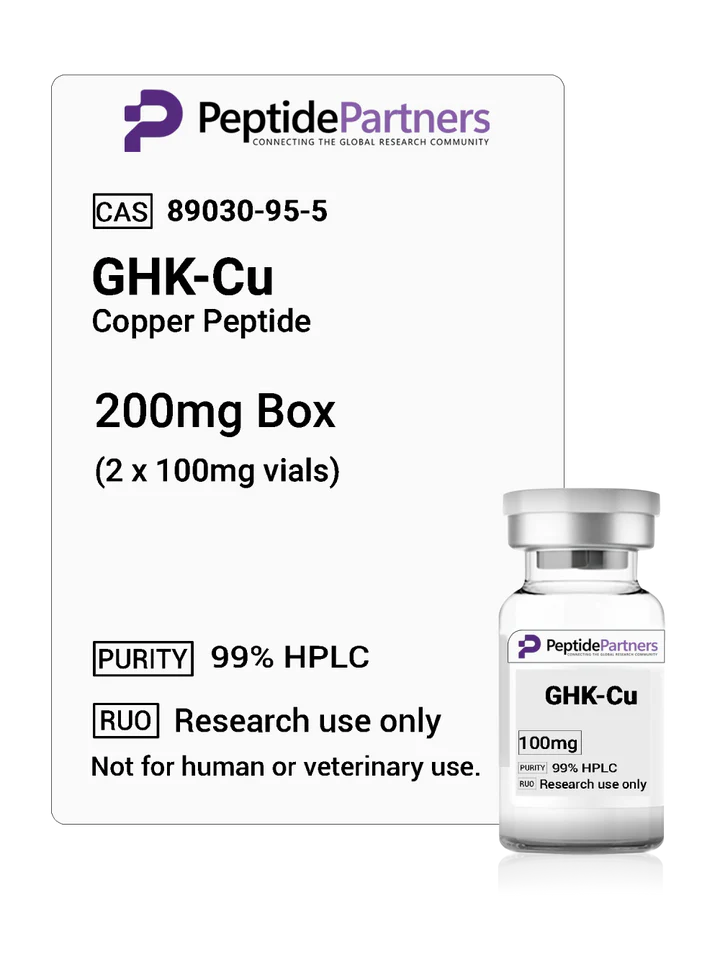
GHK-Cu (100mg vials)
Price range: $150.00 through $900.00
-
Research compound: GHK-Cu Kit, the copper-binding tripeptide glycyl-L-histidyl-L-lysine copper complex.
-
Research focus: Peptide–copper binding, fibroblast biology, collagen-related pathways, oxidative-stress models, gene expression, and ex-vivo skin research.
-
Format: 100 mg vials with 3 mL vial capacity.
-
Available box combinations: 200 mg, 500 mg, 1,000 mg, and 2,000 mg.
-
Purity: 99.84% multi-vial purity.
-
Testing status: Independently tested; purity and endotoxin screenings passed.
-
Certification: Independently certified USP <85> endotoxin safe.
-
Batch details: Manufacturer ID WF03; batch CU202604.
-
Research context: Published work includes review, human dermal-fibroblast, ex-vivo skin, keratinocyte, and oxidative-stress research.
- Independent certificate details, manufacturer IDs, and batch IDs should be reviewed before purchase when available.
- Order cancellations for full refunds are available before shipment; shipped orders cannot be cancelled or refunded.
- For damaged or incorrect goods, photograph the outer packaging, inner packaging, and product labels, then email support within 48 hours of carrier delivery.
Buy GHK-Cu Kit – Peptide Partners
Product Overview & Specifications
GHK-Cu is a copper-binding tripeptide complex also known as glycyl-L-histidyl-L-lysine copper. Peptide Partners supplies this research compound for in-vitro testing, laboratory experimentation, peptide–copper studies, cellular biology, and preclinical or ex-vivo research.
Research involving GHK-Cu has examined dermal fibroblast activity, collagen-related pathways, extracellular-matrix regulation, oxidative-stress responses, copper-associated chemistry, gene-expression patterns, and ex-vivo skin models. The available literature includes review articles and laboratory studies involving GHK or GHK-Cu; results from those studies should not automatically be attributed to every formulation or batch.
The supplied product data does not include a CAS number or molecular formula. Researchers should verify the applicable chemical identity, batch documentation, certificate of analysis, and copper-complex specification before beginning any experiment.
Product Specifications
| Specification | Details |
|---|---|
| Product name | GHK-Cu Kit |
| Compound name | Glycyl-L-histidyl-L-lysine copper complex |
| Compound type | Copper-binding research tripeptide complex |
| Primary research areas | Fibroblast biology, collagen-related pathways, oxidative-stress research, gene expression, and ex-vivo skin models |
| Product format | 100 mg vials |
| Vial size | 100 mg |
| Vial capacity | 3 mL |
| Available box combinations | 200 mg, 500 mg, 1,000 mg, and 2,000 mg |
| Multi-vial purity | 99.84% |
| Validation | Doubly validated |
| Independent testing | Yes |
| USP <85> endotoxin certification | Independently certified endotoxin safe |
| Endotoxin screening | Passed |
| Purity screening | Passed |
| Heavy-metals screening | Not provided in supplied product data |
| Manufacturer ID | WF03 |
| Batch ID | CU202604 |
| Cost per milligram | $0.45–$0.75 |
The stated 99.84% purity is based on multi-vial testing. Researchers should review the batch-specific certificate of analysis and verify the copper-complex identity before beginning any experiment.
Primary Research Studies & Findings
Regenerative and Protective Actions of the GHK-Cu Peptide in the Light of the New Gene Data
Authors: Loren Pickart and Anna Margolina
Publication: International Journal of Molecular Sciences, 2018;19(7):1987
DOI: 10.3390/ijms19071987
Reference: View publication
This review summarizes published research on GHK and GHK-Cu, including studies of dermal fibroblasts, collagen and elastin synthesis, glycosaminoglycan production, extracellular-matrix regulation, oxidative-stress chemistry, and gene-expression patterns.
The review discusses reported effects in cell, tissue, and animal models involving fibroblast function, collagen-related pathways, metalloproteinase activity, antioxidant responses, angiogenesis-related processes, and nerve-outgrowth models. It also describes gene-profiling data suggesting that GHK can influence expression of multiple genes associated with tissue remodeling, stress responses, inflammation, and DNA-repair pathways.
Because this is a narrative review that brings together findings from different experimental systems, the reported effects vary by model, concentration, formulation, and study design. Review-level claims should not be treated as proof of a specific effect for the supplied product.
Plain-English Research Summary
This review describes how researchers have studied GHK and GHK-Cu in cell, tissue, and animal models. The research includes fibroblast activity, extracellular-matrix markers, copper-associated chemistry, oxidative-stress pathways, and gene expression. These findings provide background for laboratory research but do not establish medical, cosmetic, or therapeutic claims for this product.
Synergy of GHK-Cu and Hyaluronic Acid on Collagen IV Upregulation via Fibroblast and Ex-Vivo Skin Tests
Authors: Fangru Jiang, Yanan Wu, Zhe Liu, Minhua Hong, and Yi Huang
Publication: Journal of Cosmetic Dermatology, 2023
DOI: 10.1111/jocd.15763
Reference: View publication
This study examined GHK-Cu with hyaluronic acid in human dermal-fibroblast experiments and ex-vivo skin models. The researchers assessed collagen I, collagen IV, and collagen VII expression, with particular attention to the dermal–epidermal junction and the effects of different hyaluronic-acid molecular weights.
The study reported that selected GHK-Cu and low-molecular-weight hyaluronic-acid combinations increased collagen-related markers in the tested systems. The strongest reported collagen-IV response occurred at the study’s specified 1:9 GHK-Cu-to-low-molecular-weight-hyaluronic-acid ratio, with different response magnitudes observed in cell and ex-vivo skin experiments.
These results apply to the tested combination, ratio, model, and experimental conditions. They do not establish that GHK-Cu alone, or the supplied kit at an unspecified formulation, produces the same response.
Plain-English Research Summary
This study tested GHK-Cu together with hyaluronic acid in cultured fibroblasts and ex-vivo skin. The researchers observed changes in collagen-related markers, especially collagen IV, under selected formulation conditions. The findings are relevant to laboratory skin-biology research and should not be presented as evidence of a human cosmetic or medical effect.
GHK-Cu May Prevent Oxidative Stress in Skin by Regulating Copper and Modifying Expression of Numerous Antioxidant Genes
Authors: Loren Pickart, Jessica Michelle Vasquez-Soltero, and Anna Margolina
Publication: Cosmetics, 2015;2(3):236
Reference: View publication
This paper examined proposed antioxidant mechanisms of GHK-Cu, including interactions with copper, reactive carbonyl species, lipid-peroxidation products, and antioxidant-related gene expression. The authors also discussed experimental observations involving cultured keratinocytes and ultraviolet-B exposure.
The paper describes both direct chemical interactions with reactive products and indirect effects involving expression of antioxidant-associated genes. It presents these mechanisms as part of a broader research model for understanding GHK-Cu activity in skin-related systems.
The publication is not evidence that GHK-Cu prevents oxidative stress in human skin under real-world conditions. Results from chemical assays and cell models require independent confirmation in appropriately designed experiments.
Plain-English Research Summary
This research examined how GHK-Cu may interact with reactive molecules and antioxidant-related cellular pathways in laboratory systems. The study considered both direct copper-associated chemistry and gene-expression changes. The findings are mechanistic and experimental and do not establish a human protective or therapeutic effect.
Standard Research Disclaimer
Research Use Only. Not for use in diagnostic tests.
This product is solely intended for research purposes as a chemical compound. It is designated exclusively for in-vitro testing and laboratory experimentation. All information provided about this product is educational and should be evaluated by appropriately qualified research personnel.
By law, bodily introduction of this product into humans or animals is strictly prohibited. This compound must not be used, administered, or represented as a drug, food, dietary supplement, cosmetic, skincare treatment, wound treatment, diagnostic material, or medical treatment. It is not intended to diagnose, treat, cure, or prevent any disease. It should be handled only by licensed and qualified professionals in an appropriately equipped laboratory and in accordance with applicable laws, institutional procedures, and relevant safety requirements.
| Choose pack |
2 vials × 100mg (200mg total) ,5 vials × 100mg (500mg total) ,10 vials × 100mg (1000mg total) ,20 vials × 100mg (2000mg total) |
|---|
- All of our manufacturing partners produce peptides using the Lyophilization (Freeze Drying) process, ensuring products maintain stability for shipping and storage for 12+ months.
- In lyophilized form, they are shelf-stable for many weeks. However, for long-term storage, it is recommended to store them in the freezer.
- We often hear concerns about the standard "discard after 28 days of first use" disclaimer. Don't worry, this has nothing to do with studies regarding the efficacy of specific peptides. 28 days is the FDA requirement for producers of multi-use vials to prove their bacteriostatic maintains efficacy. This minimum requirement becomes the de facto standard.
- In our experience, if you use proper sterile procedures and refrigerated storage, you can continue sampling from the same reconstituted vial for 3+ months.
Certificate records
No published certificate records are available for this product.
Search Certificate LedgerRelated products
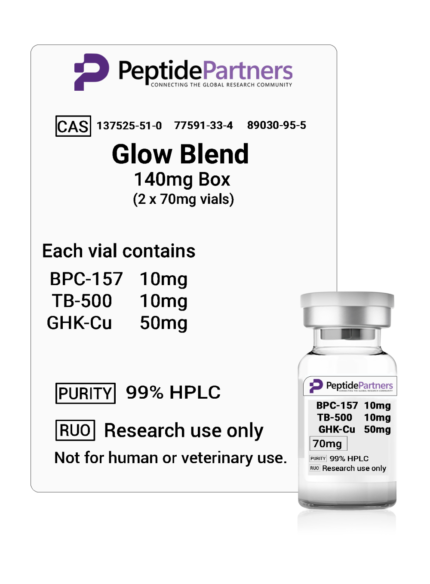
GLOW Blend: BPC-157/TB-500/GHK-Cu (70mg vials)
Price range: $182.00 through $770.00
