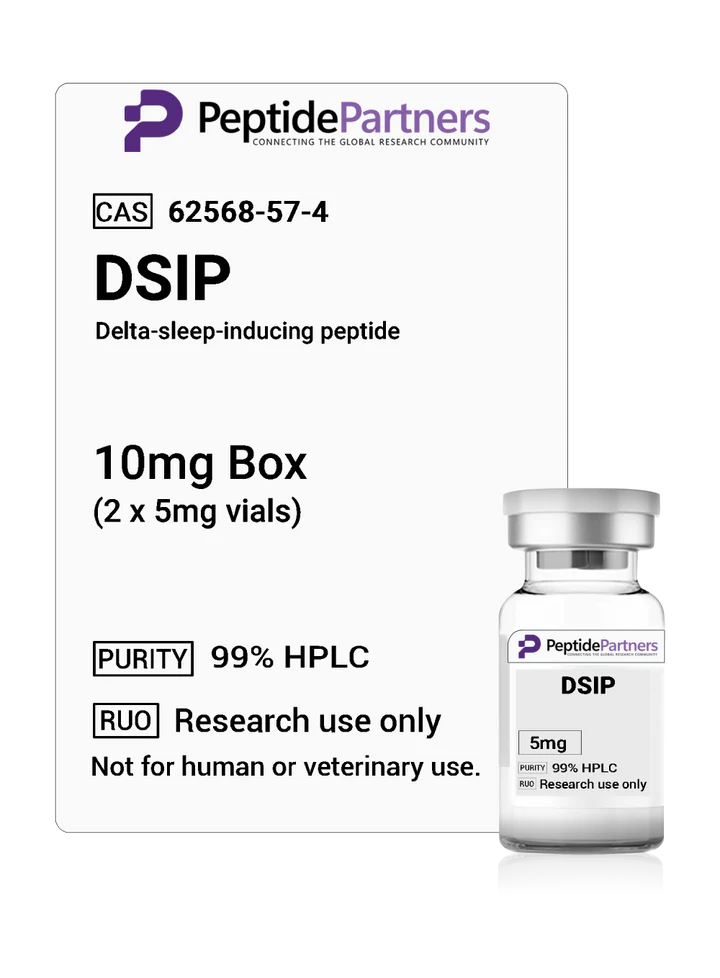
DSIP (5mg vials)
Price range: $75.00 through $305.00
-
Research peptide: DSIP, also known as delta-sleep-inducing peptide.
-
Research focus: Peptide transport, blood–brain-barrier permeability, pituitary-cell differentiation, neuroendocrine signaling, and in-vitro metabolism research.
-
Format: 5 mg vials with 3 mL vial capacity.
-
Available box combinations: 10 mg, 25 mg, and 50 mg.
-
Purity: 99.81% multi-vial purity.
-
Testing status: Independently tested; purity, endotoxin, and heavy-metals screenings passed.
-
Batch details: Manufacturer ID WF03; batch DS202605.
-
Research context: Published studies have investigated DSIP in cultured pituitary primordia, brain-microvessel endothelial-cell models, and human pheochromocytoma-cell systems.
- Independent certificate details, manufacturer IDs, and batch IDs should be reviewed before purchase when available.
- Order cancellations for full refunds are available before shipment; shipped orders cannot be cancelled or refunded.
- For damaged or incorrect goods, photograph the outer packaging, inner packaging, and product labels, then email support within 48 hours of carrier delivery.
Buy DSIP Delta-Sleep-Inducing Peptide – Peptide Partners
Product Overview & Specifications
DSIP, also known as delta-sleep-inducing peptide, is a research peptide supplied by Peptide Partners for in-vitro testing, laboratory experimentation, peptide-transport studies, neuroendocrine research, and preclinical investigation.
Published research has examined DSIP in cultured pituitary tissue, blood–brain-barrier permeability models, and human pheochromocytoma-cell systems. Research topics include pituitary-cell differentiation, transendothelial peptide flux, peptide stability, intracellular localization, and DSIP-like immunoreactive material.
These studies describe experimental cellular and tissue models and do not establish human safety, clinical efficacy, sleep-related treatment effects, or suitability for administration. Researchers should review the applicable batch documentation and certificate of analysis before beginning any experiment.
Product Specifications
| Specification | Details |
|---|---|
| Product name | DSIP |
| Alternate name | Delta-sleep-inducing peptide |
| Compound type | Research peptide |
| Primary research areas | Peptide transport, blood–brain-barrier models, pituitary biology, neuroendocrine signaling, and in-vitro metabolism |
| Product format | 5 mg vials |
| Vial size | 5 mg |
| Vial capacity | 3 mL |
| Available box combinations | 10 mg, 25 mg, and 50 mg |
| Multi-vial purity | 99.81% |
| Independent testing | Yes |
| Endotoxin screening | Passed |
| Heavy-metals screening | Passed |
| Purity screening | Passed |
| Manufacturer ID | WF03 |
| Batch ID | DS202605 |
| Cost per milligram | $6.10–$7.50 |
The stated 99.81% purity is based on multi-vial testing. Researchers should review the batch-specific certificate of analysis before beginning any experiment.
Primary Research Studies & Findings
Induction of Pituitary Cell Type Differentiation by Delta Sleep-Inducing Peptide
Authors: A. G. Héritier, O. Stettler, and P. M. Dubois
Publication: Neuroendocrinology, 1994;59(5):477–482
DOI: 10.1159/000126694
Reference: PubMed 8022523
This in-vitro study examined the effects of DSIP on pituitary-cell differentiation. Pituitary primordia from 11-day-old rat fetuses were cultured in synthetic medium containing different DSIP concentrations. The researchers used immunocytochemical methods to quantify the expression of several pituitary-cell phenotypes.
DSIP exposure during the first day of culture was associated with dose-dependent differentiation of luteinizing-hormone and thyroid-stimulating-hormone cell types. The study also reported an effect on lactotrope differentiation, although the authors noted that this response might not have been direct. No effect was observed on somatotrope or corticotrope differentiation under the tested conditions.
Plain-English Research Summary
This laboratory study examined how DSIP influenced developing rat pituitary tissue. The researchers observed changes in specific pituitary-cell types, including cells associated with LH and TSH production. The findings describe an embryonic rat-tissue model and do not demonstrate a comparable effect in humans.
In-Vitro Characterization of Blood–Brain-Barrier Permeability to Delta Sleep-Inducing Peptide
Authors: S. Raeissi and K. L. Audus
Publication: Journal of Pharmacy and Pharmacology, 1989;41(12):848–852
DOI: 10.1111/j.2042-7158.1989.tb06385.x
Reference: PubMed 2576448
This study used an in-vitro blood–brain-barrier model consisting of cultured brain-microvessel endothelial-cell monolayers. DSIP movement across the cell layer was measured using a side-by-side diffusion apparatus and high-performance liquid chromatography with ultraviolet detection.
The reported transendothelial flux increased with DSIP concentration and was linear over time under the test conditions. The measured permeability was comparable to that of certain water-soluble substances with limited blood–brain-barrier penetration. DSIP transport was bidirectional, was not altered by reduced temperature or metabolic inhibitors, and showed limited degradation during the diffusion experiments.
Plain-English Research Summary
This study examined DSIP movement across a laboratory model of the blood–brain barrier. The researchers observed concentration-dependent transport and limited degradation during the test period. These findings characterize peptide permeability in an experimental cell model and do not establish distribution, activity, or safety in humans.
Human Pheochromocytoma Cells Studied in Culture Contain Large Amounts of DSIP-Like Material
Authors: Ola Nilsson, Bo Wängberg, Anneli Wigander, Kerstin Lundmark, Annica Dahlström, Håkan Ahlman, Anders Bjartell, and Rolf Ekman
Publication source: Peptides, 1991
Reference: View publication
This study investigated DSIP-like immunoreactive material in nine human pheochromocytoma tumors and in cultured cells derived from these tumors. The researchers used immunocytochemistry, immunofluorescence, electron microscopy, and high-performance liquid chromatography to examine the location and release of DSIP-like material.
Variable proportions of cells in the primary tumors showed cytoplasmic labeling with DSIP antibodies. Cultured tumor cells displayed concentrated labeling in cell bodies, while immunogold electron microscopy localized DSIP-like material to dense-core secretory granules. Several HPLC fractions from conditioned culture media indicated release of DSIP-like material from cultured cells.
The researchers also observed differences among tumor samples in the HPLC profiles of DSIP-like material. These variations may reflect differences in peptide processing, secretion, or turnover between the cell preparations.
Plain-English Research Summary
This study looked for DSIP-like material in human tumor tissue and cultured tumor cells. The researchers found immunoreactive material stored in cellular secretory granules and detected related material in the surrounding culture medium. The findings concern tumor-cell biology and do not establish the identity, function, or therapeutic significance of the supplied DSIP product.
Standard Research Disclaimer
Research Use Only. Not for use in diagnostic tests.
This product is solely intended for research purposes as a chemical compound. It is designated exclusively for in-vitro testing and laboratory experimentation. All information provided about this product is educational and should be evaluated by appropriately qualified research personnel.
By law, bodily introduction of this product into humans or animals is strictly prohibited. This compound must not be used, administered, or represented as a drug, food, dietary supplement, cosmetic, diagnostic material, sleep aid, or medical treatment. It is not intended to diagnose, treat, cure, or prevent any disease. It should be handled only by licensed and qualified professionals in an appropriately equipped laboratory and in accordance with applicable laws, institutional procedures, and relevant safety requirements.
| Choose pack |
2 vials × 5mg (10mg total) ,5 vials × 5mg (25mg total) ,10 vials × 5mg (50mg total) |
|---|
- All of our manufacturing partners produce peptides using the Lyophilization (Freeze Drying) process, ensuring products maintain stability for shipping and storage for 12+ months.
- In lyophilized form, they are shelf-stable for many weeks. However, for long-term storage, it is recommended to store them in the freezer.
- We often hear concerns about the standard "discard after 28 days of first use" disclaimer. Don't worry, this has nothing to do with studies regarding the efficacy of specific peptides. 28 days is the FDA requirement for producers of multi-use vials to prove their bacteriostatic maintains efficacy. This minimum requirement becomes the de facto standard.
- In our experience, if you use proper sterile procedures and refrigerated storage, you can continue sampling from the same reconstituted vial for 3+ months.
Certificate records
No published certificate records are available for this product.
Search Certificate LedgerRelated products
CJC-1295 no DAC (10mg vials)
Price range: $117.00 through $888.00
Humanin (10mg vials)
Price range: $165.00 through $720.00